
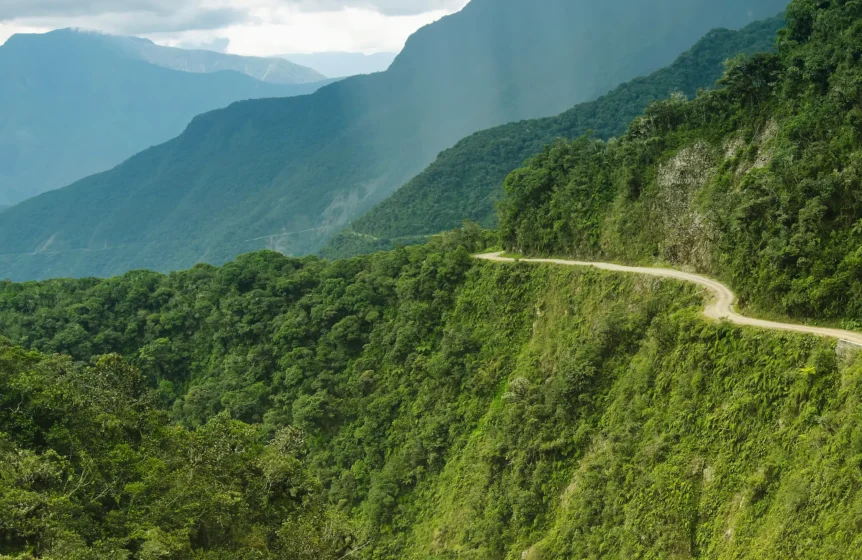
For decades it was synonymous with fear, tragedy, and silence. Today, it is one of the greatest icons of adventure tourism in South America. The Death Road, officially known as the Road to the Yungas, is not just a road: it is a living story of survival, transformation, and respect for nature.
This article explores its origins, the events that made it world‑famous, and how it evolved from the most dangerous road on the planet into a destination that attracts travelers from around the globe.
Where is the Death Road located?
The Death Road connects the city of La Paz with the tropical region of the Yungas, descending from 4,700 meters above sea level to just over 1,100 meters near Coroico.
In barely 60 kilometers, the landscape changes dramatically—from cold, arid mountains to dense, vibrant rainforest. This extreme contrast is part of its magnetism… and also the source of its historical danger.
The origin: a road built under extreme conditions
The road was built between 1931 and 1936, at a time when Bolivia lacked modern heavy machinery. Much of the work was done by hand, using picks, shovels, and dynamite.
A lesser‑known but fundamental fact of its history is that many of the workers were Paraguayan prisoners captured during the Chaco War. Conditions were brutal: constant rain, landslides, dense jungle, and near‑vertical slopes. There were deaths during construction, marking the road’s tragic character from the very beginning.
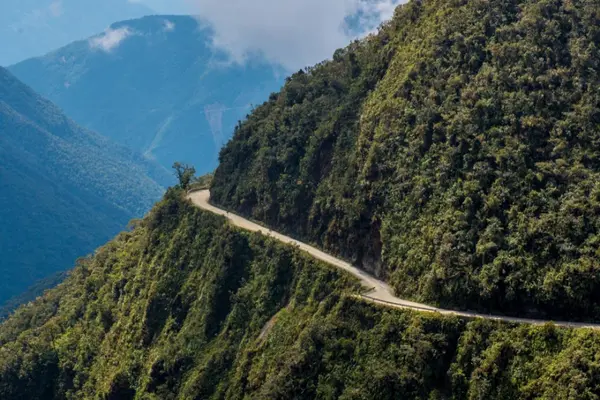
After its inauguration, it became the main connection between the La Paz highlands and the Yungas region.
Why was it considered the most dangerous road in the world?
For much of the 20th century, this road combined every possible risk factor:
- An average width of only 3 meters
- Cliffs dropping up to 800 meters with no guardrails
- Almost permanent dense fog
- Torrential rains and frequent landslides
- Constant traffic of buses, trucks, and private vehicles
The statistics were chilling: it is estimated that between 200 and 300 people died each year in accidents. Rusted crosses, vehicle remains, and improvised memorials can still be seen along the route.
In 1995, a report by the Inter‑American Development Bank officially labeled it the most dangerous road in the world, cementing its international fame.
Tragedies that shaped its history
The 1983 accident
On July 24, 1983, the worst road disaster in Bolivian history occurred: a bus carrying more than 100 passengers plunged into the abyss. There were no survivors.
The Martyrs of Democracy
In 1944, five political leaders opposing a military dictatorship were murdered and thrown from this road. Today, a plaque commemorates the event as a symbol of democratic struggle.
These events, along with hundreds of lesser‑known accidents, forged the road’s dark legend.
A unique rule in the world: driving on the left
To reduce risk, an exceptional rule was established: on the Death Road, vehicles drive on the left, unlike the rest of Bolivia.
This allowed descending drivers to better see the distance between their wheels and the cliff, while ascending vehicles had priority and stayed close to the rock wall.
The major change: the new highway and the end of deadly traffic
Between the late 1990s and 2006, Bolivia built a new paved road—wider, with tunnels and modern drainage systems. This highway replaced the old road for regular traffic.
The impact was immediate:
- Heavy traffic almost completely disappeared
- Accidents were drastically reduced
- The old road was reserved for tourism purposes
What was once a road of death began to transform into a road of experience.
The rebirth: from deadly road to world‑class tourist destination
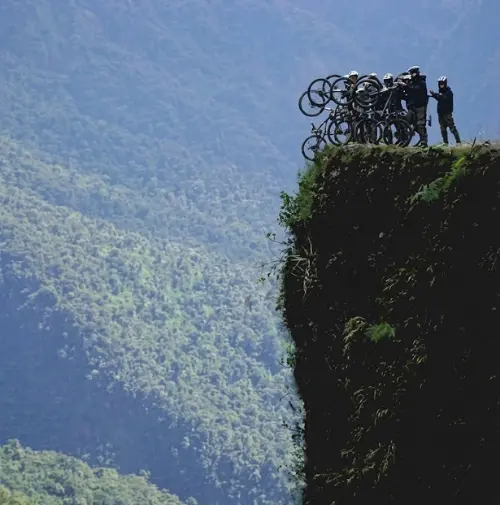
Freed from traffic, the Death Road found new life as a mountain biking route. Today, thousands of travelers each year descend by bicycle from the Andean heights into the Yungas rainforest.
What draws visitors is not only adrenaline, but a unique combination of:
- Extreme history
- Unreal landscapes
- Radical ecological transition
- A powerful sense of personal achievement
The road stopped being an enemy… and became a challenge.
More than adventure: living nature and recovery
With the reduction of traffic, wildlife returned. Recent studies have recorded the comeback of birds, mammals, and species that had disappeared for decades.
Today, the road crosses a natural corridor where the jungle has reclaimed its space, turning the journey into a deeply sensory experience.
And it is precisely after facing this route—when body and mind seek silence, rest, and connection with nature—that the Yungas reveal their true value.
The Death Road today
Today, it is no longer a road to die on, but a road to feel alive. It still demands respect, focus, and humility, yet it has become one of the most intense experiences a traveler can have in Bolivia.
Those who ride it do not simply descend a mountain—they pass through history, fear, beauty, and transformation.
And at the end of the road, the jungle awaits.
Frequently asked questions (FAQ)
Is the Death Road dangerous today?
It is much safer than in the past since it no longer has heavy traffic. However, it still requires caution, especially for those cycling.
How long does the journey to Coroico take?
The tourist descent usually takes between 4 and 6 hours, depending on weather, stops, and group pace.
Can it be visited year‑round?
Yes, although the dry season offers better conditions. During the rainy season, fog and mud intensify the experience.
Is it suitable for people without cycling experience?
Many agencies allow beginners to do the route, always with guides, proper equipment, and prior instruction.